
Millions of workers across Europe continue to face insecure jobs, poor working conditions, and limited influence over decisions in their workplaces. The social economy is often held up as evidence that more democratic and inclusive models of work are possible, yet the reality across sectors remains uneven. This tension formed the backdrop to the DICES Project’s contributions at the 10th EMES International Research Conference, where researchers examined whether democratic governance can genuinely improve job quality.
The conference brought together scholars, practitioners and policymakers to examine how social enterprises and community-based initiatives contribute to wider societal transitions. Hosted across Rotterdam and Utrecht, it provided a platform for presenting new research, testing emerging ideas and comparing developments across countries. Its focus on “scaling through communities” highlighted the growing interest in collaborative forms of social innovation and democratic governance.
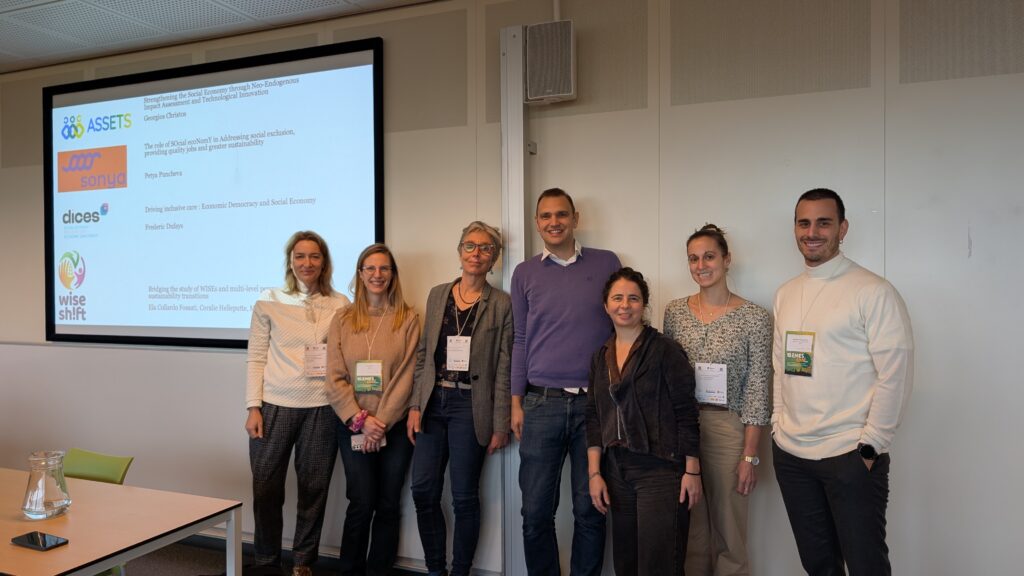
Frédéric Dufays (KU Leuven and HEC Liège – ULiège), Andreas Exner (University of Graz) and Anne Guisset (KU Leuven) presented research examining the links between organisational democracy, social dialogue, and job quality. Their contributions focused on how democratic structures are implemented within social economy organisations and what these practices mean for workers, particularly in sectors where job quality concerns are widespread.
The session concluded with a world café discussion that brought together researchers and practitioners to compare experiences across countries. The exchange highlighted both the opportunities and the difficulties involved in strengthening democratic practices at the organisational level.
As the project continues, the insights presented at 10th EMES Conference will inform the development of practical tools and policy recommendations.
The findings so far make one point clear: democratic aspirations alone are not enough. To deliver better jobs, the social economy must confront the gap between its ideals and its everyday organisational practices, an issue that is becoming increasingly urgent across Europe.